
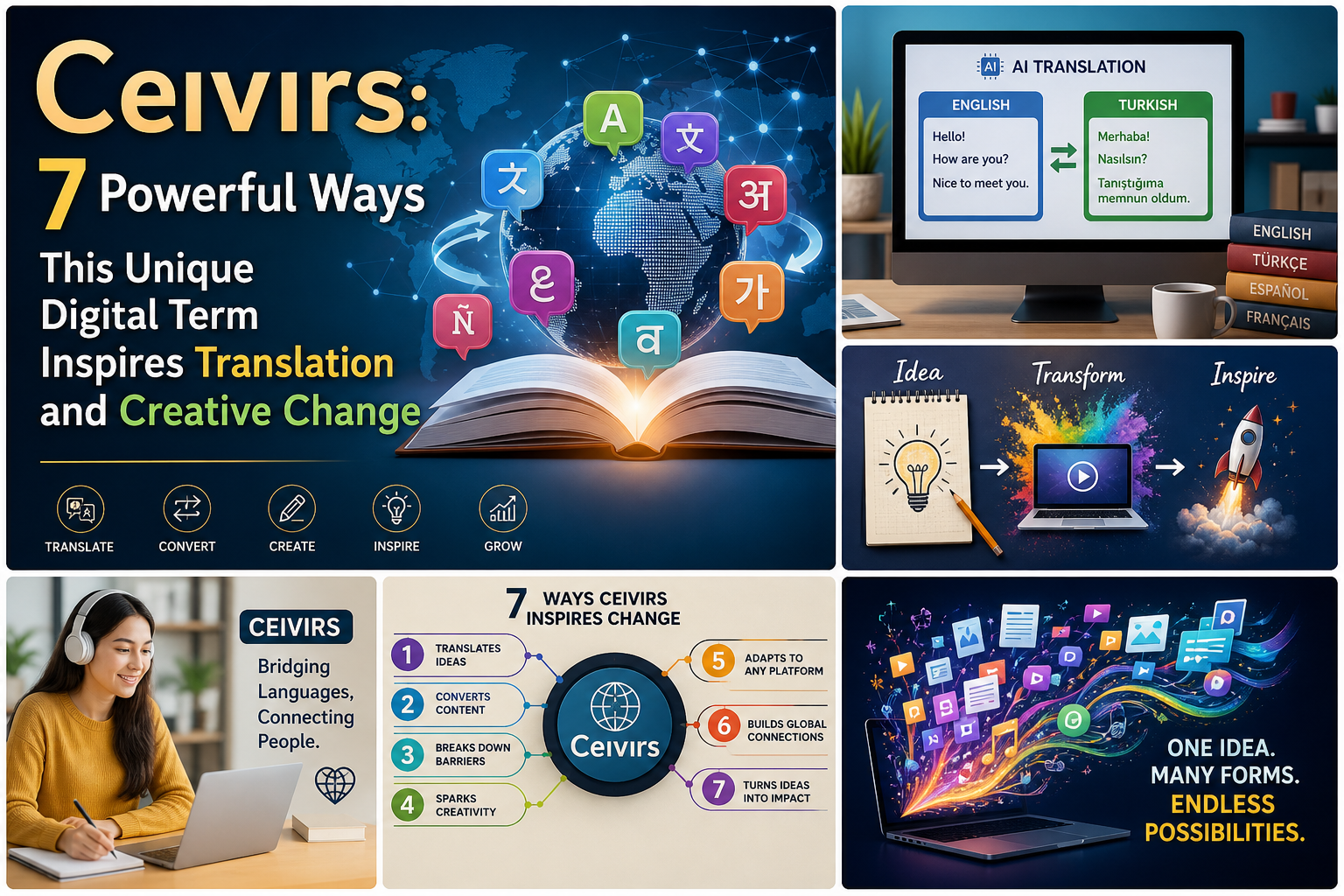
What Is Ceıvırs?
Ceıvırs appears to be a stylized or internet-adapted form connected to the Turkish root “çevir,” which means to turn, translate, or convert. Related Turkish dictionary entries show “çeviri” as “translation,” “interpretation,” “version,” and similar meanings in English.
In simple words, the idea behind this term is about change. That change may be from one language to another, from one format to another, or from one creative idea into a new digital result. For example, a person may translate a paragraph, convert a file, turn a rough sketch into a polished design, or transform a simple idea into a full blog post.
The spelling looks unusual because it uses characters that resemble Turkish letters but may not follow standard Turkish writing. Online sources describe “Ceıvır” as a stylized version of “çevir,” used in digital culture to mean turning, translating, converting, or transforming something.
That makes the term interesting for writers, creators, app builders, students, and marketers. It is short, catchy, and flexible. Better yet, it carries a strong sense of movement. It does not feel static. It suggests action.
The Language Roots of Ceıvırs
To understand this term, we need to look at Turkish. The Turkish word “çeviri” is widely used for translation. It can also connect with interpretation, rendering, and versioning, depending on context.
That matters because modern digital life is full of translation and conversion. People translate websites, subtitles, documents, product pages, social captions, and emails every day. Tools like Canva now promote AI-powered document translation features that help users convert content into many languages, showing how common translation technology has become in everyday work.
But language is only one part of the story. “Turn” and “convert” are also powerful ideas. In digital work, people often convert:
| Original Form | Converted Form |
|---|---|
| Text | Image |
| Blog post | Social media caption |
| Video | Transcript |
| Turkish text | English text |
| Idea | Brand campaign |
| Draft | Finished article |
This is where Ceıvırs becomes more than a word. It becomes a useful concept for transformation.
Why Ceıvırs Matters in the Digital Age
The internet loves short, flexible words. A term can begin in one language and then grow into a broader idea. That is exactly why a word connected to translation can become useful in tech, design, education, and branding.
Today, people do not only “translate” words. They translate meaning. A business translates its mission into a slogan. A designer translates a feeling into a logo. A teacher translates a hard lesson into a simple example. A creator translates a thought into a video.
That is the modern value of this concept. It fits many fields because almost every field now depends on turning one thing into another.
Ceıvırs in Translation and Communication
Translation is one of the clearest uses of the idea. When people speak different languages, translation helps them understand one another. It supports business, travel, education, healthcare, entertainment, and global friendships.
Good translation is not just word swapping. It needs tone, culture, purpose, and clarity. A phrase that sounds friendly in one language may sound too formal in another. A joke may not work after direct translation. A product description may need local examples to feel natural.
That is why professional translation still matters, even with AI tools. AI can help speed up work, but human judgment brings meaning, emotion, and cultural sense.
Ceıvırs and AI Translation
AI translation tools are growing fast because people need quick multilingual content. Students use them to understand lessons. Businesses use them to reach new customers. Creators use them to share content with global audiences.
Still, the best results come when people review AI output carefully. A smart workflow looks like this:
- Write clear original content.
- Translate it with a reliable tool.
- Review the tone and meaning.
- Adjust cultural examples.
- Proofread before publishing.
This keeps the message smooth, natural, and trustworthy.
Ceıvırs in Creative Transformation
Creativity is all about transformation. A blank page becomes a story. A rough voice note becomes a podcast. A plain product becomes a strong brand. A simple idea becomes something people can see, hear, and share.
That is why this term works well for creative fields. It captures the feeling of turning raw material into something valuable.
For example:
| Creative Input | Creative Output |
|---|---|
| A slogan idea | A full ad campaign |
| A sketch | A polished illustration |
| A paragraph | A video script |
| A lesson plan | An animated explainer |
| A product photo | A social media post |
This kind of transformation is at the heart of digital creativity. It is also useful for content marketing, where one strong idea can become many pieces of content.
Ceıvırs for Business and Branding
A unique term can be powerful in branding. It may stand out because it is short, unusual, and memorable. For a translation app, creative AI platform, design studio, or content conversion tool, a word like this can suggest speed, change, and smart digital movement.
However, businesses should be careful. Before using any unique term as a brand name, they should check:
| Branding Check | Why It Matters |
|---|---|
| Trademark availability | Avoids legal trouble |
| Domain name availability | Helps build a website |
| Pronunciation | Makes the brand easier to remember |
| Meaning in other languages | Prevents confusion |
| Search results | Shows competition and reputation |
| Audience fit | Makes sure the name feels right |
A good name should not only sound cool. It should also be clear enough for users to understand.
Benefits of Understanding Ceıvırs
This concept can help different people in different ways.
Students can use it to understand translation and language change. Writers can use it as a reminder to adapt content for different readers. Marketers can use it to think about converting one message into many formats. Designers can use it as a creative trigger. Businesses can use it as a branding idea.
The biggest benefit is mindset. It reminds us that content is not fixed. A good idea can be shaped, improved, translated, simplified, expanded, and shared.
That is a powerful lesson in a world where content moves across platforms every day.
Common Mistakes Around Ceıvırs
Because the spelling is unusual, confusion is natural. Some people may think it is a typo. Others may connect it with Turkish translation terms. Some may use it as a creative digital word rather than a standard dictionary term.
Here are common mistakes:
| Mistake | Better Understanding |
|---|---|
| Thinking it has only one meaning | It can suggest translation, turning, or conversion |
| Treating it as standard Turkish | It appears more stylized than standard |
| Using it without context | Explain it clearly for readers |
| Overusing it in SEO content | Use it naturally and sparingly |
| Ignoring audience clarity | Make sure readers understand the term |
Clarity matters. A unique word can help SEO and branding, but only when the content explains it well.
Practical Uses of Ceıvırs
Here are some simple ways the idea can be used:
In Education
Teachers can use the concept to explain how ideas change form. A history lesson can become a timeline. A science topic can become a diagram. A hard paragraph can become a simple summary.
In Translation
A translator may turn one language into another while keeping the meaning natural. This is useful in books, websites, legal documents, product pages, and travel guides.
In Marketing
A marketer may convert a blog article into emails, ads, short videos, and social posts. This saves time and keeps the brand message consistent.
In AI Tools
AI platforms often help users turn text into images, notes into summaries, or long videos into clips. This fits the broader idea of digital transformation.
In Branding
A company may use the term to suggest smart change, fast conversion, or multilingual communication.
FAQs About Ceıvırs
1. What does Ceıvırs mean?
It appears to be a stylized digital term connected to the Turkish root “çevir,” meaning to turn, translate, or convert. It can be used to describe transformation in language, content, or creative work.
2. Is Ceıvırs a standard Turkish word?
Not exactly. Standard Turkish uses words like “çevir” and “çeviri.” The spelling “Ceıvırs” looks more like an online or stylized variation.
3. Can Ceıvırs be used for SEO?
Yes, but it should be used carefully. Since it is unusual, the article should explain the meaning clearly. This helps readers and search engines understand the topic.
4. Is Ceıvırs related to translation?
Yes. It is strongly connected to the idea of translation because of its link to Turkish words related to translating and turning.
5. Can businesses use Ceıvırs as a brand name?
Possibly, especially for translation, AI, content creation, or conversion tools. However, businesses should check trademarks, domains, and audience understanding first.
6. Why is the spelling unusual?
The spelling may come from adapting Turkish-style characters for online use. It may also be used to create a unique digital identity.
7. How can creators use this concept?
Creators can use it as a mindset for turning one idea into many formats, such as blog posts, videos, images, captions, newsletters, and scripts.
Conclusion
Ceıvırs is a fascinating term because it blends language, technology, and creativity. Its roots point toward translation, turning, and conversion, but its digital use can go much further. It can describe the way people transform ideas, content, messages, and media in today’s fast-moving online world.
Whether you are a student, translator, creator, marketer, or business owner, this concept reminds you of something simple but powerful: one idea can become many things. With the right tools, clear thinking, and creative effort, a small starting point can turn into something useful, beautiful, and meaningful.
