
What is Disney Plussing? An In-Depth Guide to Extraordinary Experiences
When Walt Disney set out to build his empire, he realized that meeting standard expectations was a surefire way to fade into the background. He introduced a transformative operational philosophy known today as Disney plussing, a continuous improvement strategy that turns a good concept into an unforgettable experience. By treating every product, service, and project as a living entity that can always be enhanced, this mindset pushes creative boundaries far beyond ordinary business limits.
The “Quick Bio” Feature Table
The Historical Origins of a Creative Verb
To fully grasp how Disney plussing works, one must look back at the early days of Disneyland in the mid-1950s. Before the park opened in Anaheim, California, animated films were the primary driver of the company’s success. However, Walt Disney grew increasingly frustrated by the static nature of cinema. Once a motion picture was finalized, printed onto film reels, and shipped to theaters, it was immutable. If Walt discovered a scene he disliked or realized a joke could be timed better, he couldn’t change it. The art was locked in place.
The creation of a physical theme park changed everything. Walt viewed Disneyland not as a finished real estate project, but as a living, breathing canvas. In a famous 1956 interview with journalist Pete Martin, Walt explained that the park would never be truly completed. It was something he could keep developing, tweaking, and actively improving.
This was not a passive observation; it was an aggressive operational directive. Walt began using the word “plus” as an action verb during production meetings and park walkthroughs. If an Imagineer brought an excellent design for a ride, Walt wouldn’t simply approve it and move on. He would ask his team, “How can we plus this?”
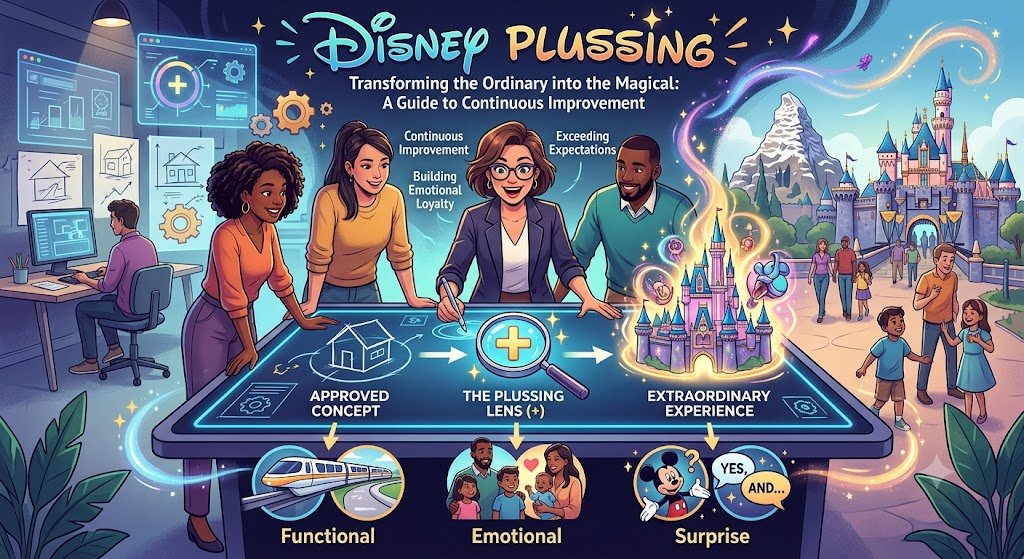
This framework follows a seamless progression: it takes an Approved Concept, views it critically through the Plussing Lens, and ultimately delivers an Extraordinary Experience that standard workflows simply cannot replicate. This linguistic shift transformed a simple mathematical concept into an ongoing cultural mandate to exceed baseline expectations.
The Famous $350,000 Christmas Parade Dilemma
Perhaps the clearest example of Disney plussing in action occurred in 1957, just a couple of years after Disneyland opened its gates. Walt decided that the park needed a spectacular, grand-scale Christmas parade. When the accounting and finance departments calculated the numbers, they realized the parade would cost a staggering $350,000—an extraordinary sum of money at the time.
The financial team immediately arranged a meeting to dissuade Walt from the investment. Their argument was logically sound from a traditional accounting perspective:
-
The park was already projected to be at maximum capacity during the holiday season.
-
Guests were already buying tickets and entering the gates without the promise of a parade.
-
Because the public did not expect a parade, no one would complain if it didn’t exist.
-
Therefore, spending $350,000 would not generate any incremental short-term revenue.
Walt listened to their rationale and delivered a reply that encapsulates the entire framework: “That’s exactly why we should do it. We should give them the parade precisely because they don’t expect it.”
Walt understood that long-term brand equity is built in the spaces where customer expectations are completely flat. When a business gives people exactly what they pay for, it satisfies them. But when a business delivers an unexpected layer of generosity, it converts casual consumers into lifelong advocates. The parade went ahead, creating an enduring holiday tradition that solidified the park’s reputation as a place of unmatched wonder.
The Core Structural Dimensions of a Product Upgrade
When modern organizations adopt Disney plussing within their development pipelines, they typically analyze their offerings through three distinct lenses. These dimensions ensure that enhancements are intentional, impactful, and directly linked to human psychology.
1. The Functional Dimension
The functional level focuses on removing micro-frictions that the user might have accepted as a normal part of life. This means looking at an interface, a service workflow, or a physical layout and asking how it can be made instinctively smoother.
A classic historical example is how theme park garbage disposal was engineered. Walt noticed that guests would walk roughly thirty steps carrying trash before dropping it on the ground if they didn’t encounter a waste receptacle. Instead of installing aggressive disciplinary signage or increasing cleaning staff budgets, he simply commanded that trash cans be placed exactly thirty steps apart throughout the park. This functional adjustment harmonized the environment with natural human behavior.
2. The Emotional Dimension
The emotional level focuses on injecting comfort, warmth, and validation into moments that are traditionally cold or stressful. In digital product development, this occurs when an engineering team transforms a generic, alarming error message into a supportive, guiding conversation.
If a system hiccup occurs, a standard application might display a harsh code error. A team practicing continuous enhancement will design a friendly, reassuring prompt that guides the user back to safety without making them feel at fault. It addresses the emotional state of the human behind the screen.
3. The Element of Surprise
This dimension involves surfacing thoughtful touches that the consumer never requested, expected, or imagined. It requires looking at touchpoints where expectations are low and adding a spark of delight.
In customer service ecosystems, this is mirrored when support professionals are empowered to craft spontaneous magical moments—such as sending a handwritten note to an exhausted customer or proactively waving a transactional fee during a difficult life transition.
Cultivating a “Yes, and…” Collaborative Ecosystem
To successfully execute Disney plussing inside an organization, the corporate culture must shift how it handles feedback. Traditional corporate brainstorming sessions often suffer from critical deceleration, where ideas are dissected and shut down prematurely by skepticism or budgetary constraints.
To combat this, the ideation framework relies heavily on the foundational rules of theatrical improvisational comedy: replacing “No, but…” with “Yes, and…”
Traditional Critique: “That’s a good idea, BUT it’s too expensive and hard to build.”
Plussing Critique: “YES, that’s a fascinating idea, AND we could make it feasible by adjusting our launch phases.”
This structural approach was deeply integrated into Pixar Animation Studios through a process known as the “Braintrust.” When directors and animators gather to critique an early, rough cut of a feature film, the rule is clear: you are not permitted to simply point out a narrative flaw or tear a scene apart. If you identify a problem, your critique must be delivered as an additive layer—a positive asset designed to elevate the existing material toward perfection. This creates a safe psychological space where team members collaborate to build up concepts rather than competing to destroy them.
Translating the Philosophy into Modern Digital Design
You do not need to operate a physical theme park or a multi-billion dollar animation studio to apply these principles. In today’s digital landscape, the most successful software platforms, web properties, and service agencies use this methodology to stay relevant and prevent customer churn.
Optimizing the Waiting Experience
Waiting naturally creates psychological tension. Whether a user is waiting for a page to load, a file to export, or a physical delivery to arrive, their anxiety rises as time ticks away. Tech companies combat this by introducing whimsical loading animations, micro-interactions, or bite-sized educational tips inside empty states. These elements don’t necessarily speed up the server side, but they manage human perception, turning a boring delay into a moment of light entertainment.
Celebrating User Milestones
Many applications fulfill their primary task and stop there. A fitness app tracks a run; an invoice tool sends a bill. However, a product that incorporates continuous creative upgrades looks for moments of completion to celebrate with the user. Delivering a subtle burst of digital confetti, a warm message of congratulations, or a beautifully visualized progress milestone transforms a routine, mechanical action into an emotionally rewarding achievement.
Proactive Value Architecture
Modern content marketing and customer engagement rely on providing extreme value before a transaction even takes place. Instead of publishing surface-level write-ups that mimic every other piece of information on the internet, companies practicing this philosophy build comprehensive, interactive toolsets, highly detailed tactical guides, and free resources that exceed what competitors charge for. They make the free experience better than the paid experiences found elsewhere in the market.
Conclusion: Rejecting the Gravity of Mediocrity
The ultimate lesson of Disney plussing is that excellence is never a static destination; it is an ongoing, daily choice to reject mediocrity. It is incredibly easy for a business or a creator to achieve a minor level of success, rest on their laurels, and maintain the status quo. However, the moment a product stops evolving is the exact moment it begins its descent into irrelevance.
By constantly examining your customer journeys, identifying the small details that others overlook, and asking how you can add an extra layer of care, you protect your work from being commoditized. In a world full of standard, forgettable options, putting in more care than you absolutely have to is the ultimate competitive advantage.
Frequently Asked Questions
1. What does the term “Disney plussing” mean in business?
In a business context, it refers to the practice of continuously improving a product, service, or customer experience even when it already meets baseline expectations. It is about intentionally adding unexpected value, refining tiny details, and exceeding what the customer anticipates to build intense brand loyalty.
2. How does plussing differ from standard quality control?
Quality control is defensive; its goal is to eliminate mistakes, fix defects, and ensure a product meets minimum acceptable standards. Plussing is offensive; it assumes the product is already functional and error-free, and focuses on how to creatively elevate that good experience into something remarkable and emotionally engaging.
3. Does implementing this concept require a massive budget?
Not at all. While famous historical examples involve large investments like the 1957 Christmas parade, the true spirit of the concept lives in low-cost, high-impact details. Rewriting technical error messages to sound warm and human, adding helpful micro-animations, or writing a personalized follow-up email costs almost nothing but deeply alters user perception.
4. How do teams practice this without delaying project deadlines?
The process relies on separating generation from evaluation. During initial collaborative phases, teams use “Yes, and…” thinking to rapidly iterate and expand on possibilities without letting timelines restrict creative flow. Once a high-volume pool of enhancements is established, management selects the highest-impact, lowest-friction upgrades to implement within the production window, ensuring efficiency.
5. Can this mindset be applied to personal development?
Yes. On an individual level, it means looking at your daily routines, professional deliverables, and personal relationships, and finding small ways to add extra care. Whether it is spending five extra minutes polishing a presentation for a client or adding a thoughtful, personal touch to a gift for a loved one, it elevates ordinary habits into meaningful actions.
